
Search funds / Traditional search fund
SEO, AI search, and paid ads for investor-backed search funds.
You have committed capital, a board, and a five-to-seven year hold. Marketing has to do two jobs at once: move the operating number this quarter, and build an asset that still looks like an asset when a diligence team pulls it apart at exit.
Running a different structure? See the self-funded search page.
Traditional search fund
What is usually true at close
None of this is a marketing problem yet. It becomes one the first month the seller is gone and the phone is quieter than the model said it would be.
- A cap table of investors who expect a quarterly update with real numbers in it
- A larger platform business, often multi-location or multi-market, with wildly uneven visibility between them
- An add-on thesis, which means the marketing system has to be repeatable rather than bespoke
- A board that will ask what customer acquisition cost is, and will not accept a lead count as the answer
- An exit years out, where a buyer's diligence team will test whether growth was bought or built
How we do it
Three channels, run as one system.
Rankings, answer engines, and paid search feed each other. The reviews that lift your map rank are the same reviews an AI answer quotes, and the zones where both are weak are the only zones that should be costing you ad spend.
Local SEO
Ranking the business across its whole service area on Google Maps and organic search, measured neighborhood by neighborhood instead of by one citywide keyword that flatters the report.
With multiple locations the failure mode is averaging. A portfolio that looks healthy in aggregate is usually two strong markets subsidizing four invisible ones. We track every market separately and roll it up, so the board sees the distribution and not just the mean.
What the work is
- A full rank baseline before anything changes, so you know what you actually bought
- Google Business Profile custody, then categories, services, and service-area cleanup
- Citation and NAP consistency after the entity or the ownership changes hands
- Service and location pages built for the terms that convert, not the terms with volume
- Review velocity, because rating and volume move map rank as much as content does
AI Search Visibility
Getting the business named in the answer when someone asks ChatGPT, Google AI Overviews, Gemini, Perplexity, or Copilot who to hire in your market.
Answer engines resolve a business to an entity, and multi-location operators are where entity data gets messy fastest: inconsistent names, legacy locations, duplicate profiles, franchise-era citations. Cleaning that up is unglamorous and it is the difference between being cited and being invisible.
What the work is
- Baseline tracking of which prompts surface you, which surface a competitor, and which surface nobody
- Entity consistency: one name, one address, one phone, one description everywhere a model can read it
- Schema and structured data, so services, service area, and hours are parsed instead of guessed
- Content written to answer the question directly, in the shape an answer engine will lift
- Depth in the review corpus, because AI answers quote what customers actually wrote
Paid Advertising
Google Search and Local Services Ads pointed only at the zones and terms where organic visibility is not carrying the load yet.
Spending the same amount per market is the most common waste we inherit. Some markets need ads, some need a page and twenty reviews. The rank data decides. With offline conversion import, the CAC you report to the board survives contact with the actual job data.
What the work is
- Budget mapped to the rank data: spend where you are invisible, pull back where you already rank
- Local Services Ads and Google Guaranteed where the category supports them
- Call tracking and offline conversion import, so a booked job is the conversion, not a click
- Search-term and negative-keyword discipline from the first week, not the first quarterly review
- Reporting that ends at cost per booked job
Proof
What that looks like in practice.
A campaign from our own client base. Not a search-fund portfolio company, but the same work on the same kind of local business.
Google Ads · one client account, first month after we took it over
41% less spend, 25% more conversions
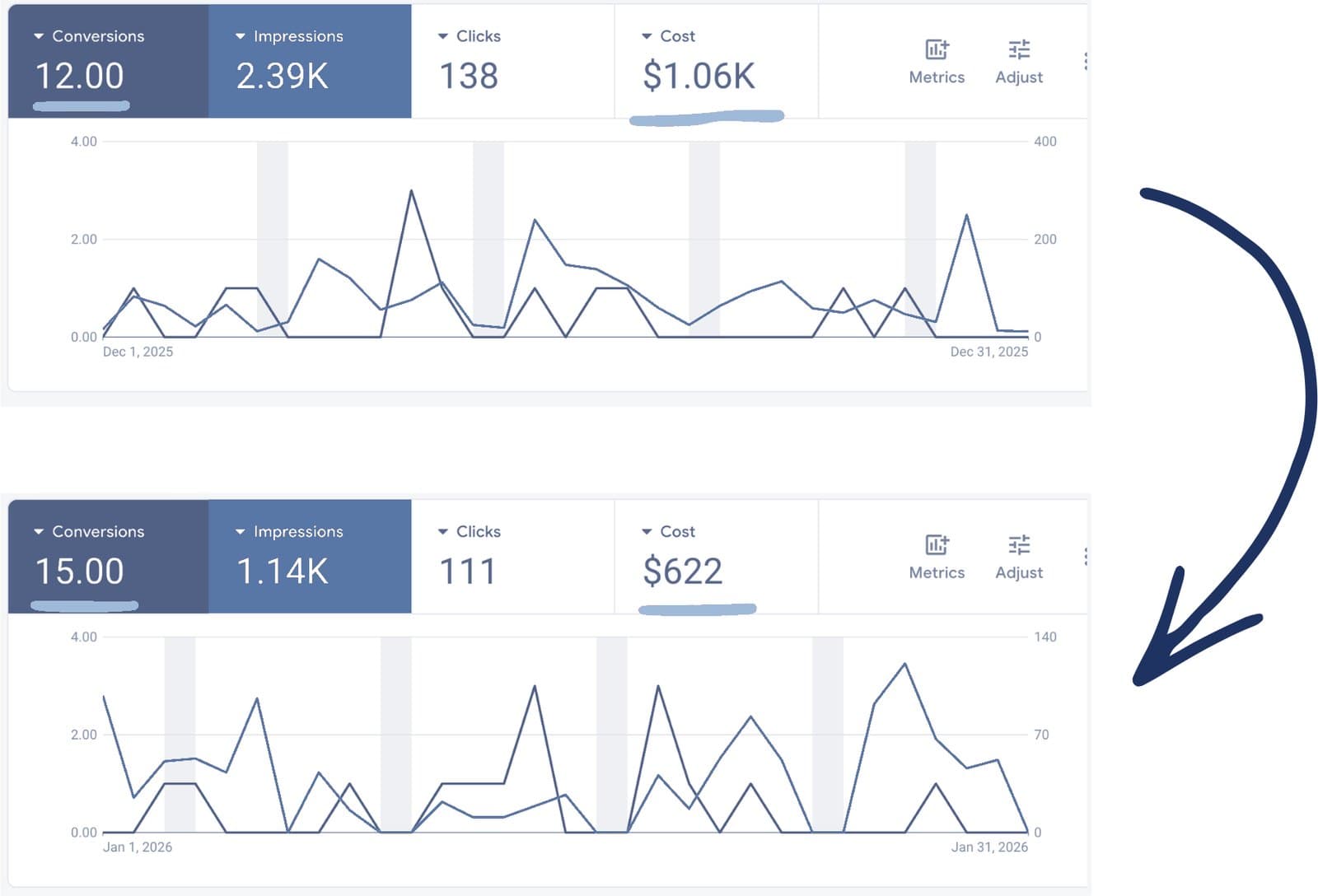
Results shown are from Tiger Digital client campaigns. Individual results vary.
Sequencing
The playbook, and why it is the asset
Anyone can run one good campaign. What holds value over a five-year hold is a system that gets applied identically to location twelve and location one, so the growth story is repeatable and the diligence story is clean.
- 1
Diligence and the first 30 days
Baseline every market the same way before any change ships. You cannot show a board a trend line that starts after you already fixed things, and you cannot show a buyer one either.
- 2
Days 30-90: one system, every location
Profiles, schema, tracking, naming conventions, and review flow standardized, so onboarding a location is a checklist rather than a project.
- 3
Days 90-180: channel mix per market
Budget reallocated market by market based on where visibility is actually missing. This is normally where the first meaningful efficiency gain shows up.
- 4
Ongoing: built to bolt on
Every add-on gets the same 30-day onboarding: custody, baseline, standardize, grow. The playbook travels with the platform, which is part of what the next buyer is paying for.
Reporting
What the board sees
Written for the quarterly update, not for a marketing audience. Every number traces back to a source your investors can check.
- Per-location rank tracking, with a portfolio roll-up
- Share of AI answers by market and by prompt set, tracked over time
- Blended and paid CAC, with offline conversions imported so the number is real
- A board-ready section every quarter, in your format, that you do not have to rebuild
- A clean, continuous attribution history, because the buyer's diligence team will ask for it
Questions searchers ask
The ones that come up on every first call.
- Can you work across multiple locations or brands?
- Yes, and it is the case the playbook is built for. Each market gets its own baseline and its own budget decision, all rolled up into one portfolio view so you are not reconciling five agency reports.
- How do you handle add-on acquisitions?
- The same 30-day onboarding runs every time: take custody of the digital assets, baseline before changing anything, standardize onto the platform's conventions, then grow. Doing it identically each time is what makes the growth defensible later.
- What exactly do you report to the board?
- Customer acquisition cost blended and by paid channel, the rank distribution across markets, share of AI answers, and the movement in rating and review volume. We write it as a section you can paste into the update rather than a dashboard login nobody opens.
- Do you replace an in-house marketing hire?
- Usually we come before one, then work alongside one. Early on there is rarely enough volume to justify a full-time specialist in every channel. When you do hire, we either hand over the systems or keep the channels the hire does not cover.
- Why does AI search matter over a five-year hold?
- Because the share of local research that starts in an answer engine instead of a results page has only moved in one direction. A business that is invisible there in year one has a structural problem by year five, and it is exactly the sort of thing a sophisticated buyer's diligence team now checks.
Still deciding which structure fits? Start with the overview, or read the self-funded search page.
Let’s find out what’s holding your business back.
Schedule a short call with our team to discuss what’s holding your business back and how we can help.