
Search funds / Self-funded search
SEO, AI search, and Google Ads for self-funded searchers.
You signed a personal guarantee and the note starts amortizing this month. Marketing has to pay for itself quickly, and it has to avoid breaking what the seller spent thirty years building. That tension is the whole job.
Running a different structure? See the traditional search fund page.
Self-funded search
What is usually true on day one
None of this is a marketing problem yet. It becomes one the first month the seller is gone and the phone is quieter than the model said it would be.
- An SBA 7(a) note with a personal guarantee, and debt service due whether or not the phone rings
- A seller whose lead flow ran on word of mouth and a name everyone in town already knew
- A Google Business Profile somebody else claimed years ago and nobody can log into
- A website nobody has touched since the last redesign, with no tracking on the phone number
- No marketing hire in the budget, and no spare hours to become the marketing hire yourself
How we do it
Three channels, run as one system.
Rankings, answer engines, and paid search feed each other. The reviews that lift your map rank are the same reviews an AI answer quotes, and the zones where both are weak are the only zones that should be costing you ad spend.
Local SEO
Ranking the business across its whole service area on Google Maps and organic search, measured neighborhood by neighborhood instead of by one citywide keyword that flatters the report.
For a single-location or single-service-area business, the whole game is the grid. The seller almost certainly ranks well within a mile of the shop and disappears past it. That gap is the cheapest growth available to you, and it does not require a bigger ad budget.
What the work is
- A full rank baseline before anything changes, so you know what you actually bought
- Google Business Profile custody, then categories, services, and service-area cleanup
- Citation and NAP consistency after the entity or the ownership changes hands
- Service and location pages built for the terms that convert, not the terms with volume
- Review velocity, because rating and volume move map rank as much as content does
AI Search Visibility
Getting the business named in the answer when someone asks ChatGPT, Google AI Overviews, Gemini, Perplexity, or Copilot who to hire in your market.
Answer engines lean hard on entity consistency and review depth, which is exactly what gets scrambled during an ownership change. Cleaning that up protects the referral habit the seller built and puts you in answers his competitors have not thought about yet.
What the work is
- Baseline tracking of which prompts surface you, which surface a competitor, and which surface nobody
- Entity consistency: one name, one address, one phone, one description everywhere a model can read it
- Schema and structured data, so services, service area, and hours are parsed instead of guessed
- Content written to answer the question directly, in the shape an answer engine will lift
- Depth in the review corpus, because AI answers quote what customers actually wrote
Paid Advertising
Google Search and Local Services Ads pointed only at the zones and terms where organic visibility is not carrying the load yet.
Ads are the only channel that produces calls in week one, which is why they usually go first when there is debt service. But they go on narrowly: the zones the rank data says you are invisible in, the services with the best margin, and nowhere else until the numbers say otherwise.
What the work is
- Budget mapped to the rank data: spend where you are invisible, pull back where you already rank
- Local Services Ads and Google Guaranteed where the category supports them
- Call tracking and offline conversion import, so a booked job is the conversion, not a click
- Search-term and negative-keyword discipline from the first week, not the first quarterly review
- Reporting that ends at cost per booked job
Proof
What that looks like in practice.
A campaign from our own client base. Not a search-fund portfolio company, but the same work on the same kind of local business.
Google Ads · one client account, first month after we took it over
41% less spend, 25% more conversions
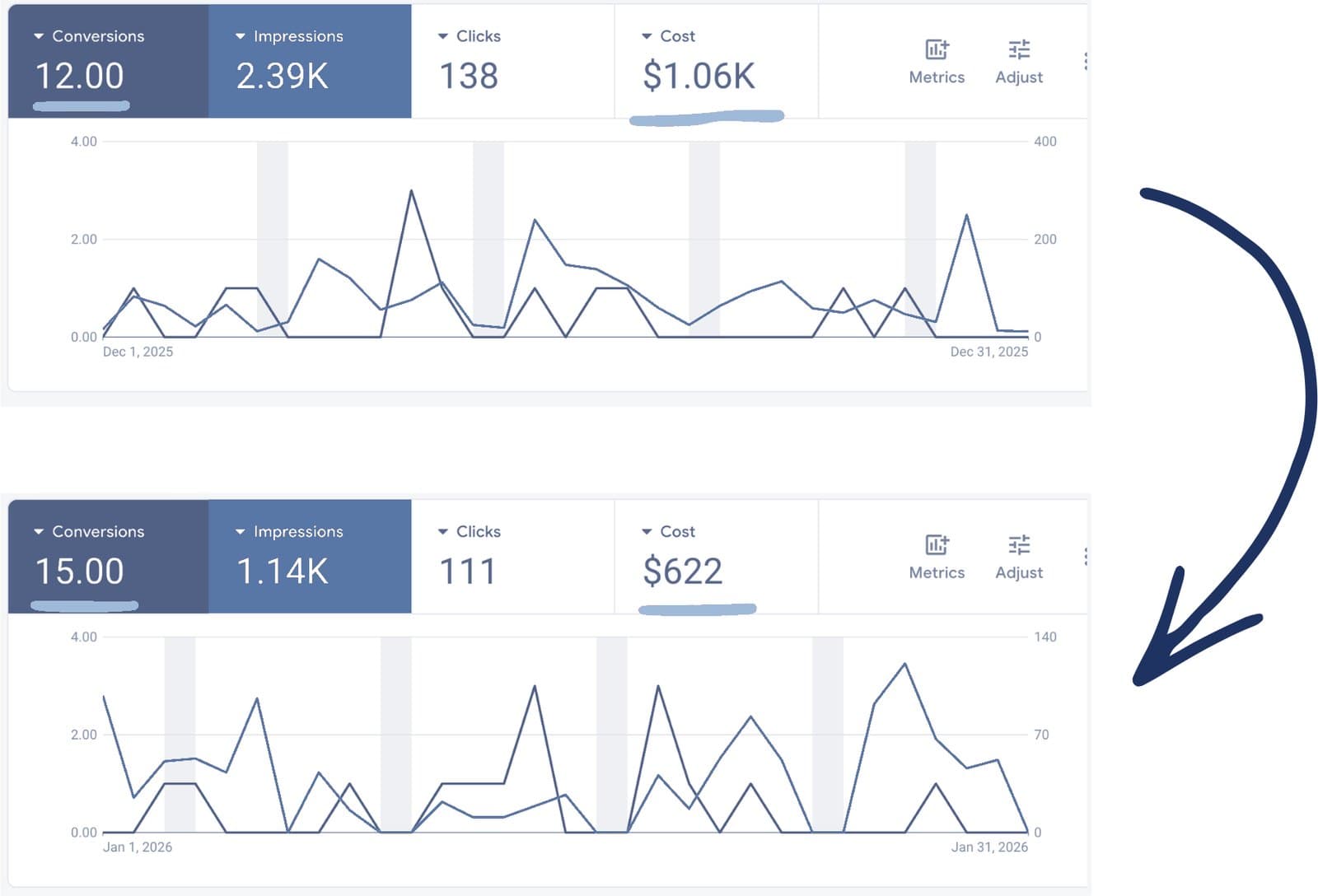
Results shown are from Tiger Digital client campaigns. Individual results vary.
Sequencing
The first 90 days
The sequence matters more than the tactics. Most of the damage we get called in to undo came from optimizing something before taking custody of it, or rebranding before anyone checked what was carrying the rankings.
- 1
Weeks 1-2: take custody
Business profile, domain, registrar, hosting, ad accounts, Analytics, Search Console, call tracking. Before anything gets optimized it has to be in your name, and this is the step that quietly takes the longest.
- 2
Weeks 2-4: baseline what you bought
Rank tracking across the real service area, AI prompt tracking, and an honest read on which of the seller's leads came from search versus from the seller. You cannot show progress from a starting line you never measured.
- 3
Weeks 4-8: protect, then fix
Nothing gets renamed or redirected until we know what carries the rankings. Then profile, categories, citations, schema, and the pages that already earn impressions but do not convert.
- 4
Weeks 6-12: turn on demand
Ads go live in the low-visibility zones only. Reviews start flowing from the customer base the seller already earned, which is usually the single highest-leverage asset nobody in the deal thought to value.
Reporting
What lands in your inbox every month
You are the operator, the CFO, and the marketing department. The report is built to be read in five minutes between jobs.
- Rank tracking on the same points every month, so movement is comparable
- Cost per booked job, not cost per click
- Rating and review count against the two or three competitors who actually take your calls
- A one-page read you can forward to your lender or your accountant without translating it
Questions searchers ask
The ones that come up on every first call.
- Should I rename the business after I buy it?
- Usually not right away. The seller's name is carrying reviews, citations, direct search volume, and in most markets the referral habit of everyone in town. If a rebrand is part of the thesis, we sequence it: stand the new entity up alongside the old one, migrate the profile and citations in a controlled order, and keep the review history intact. Renaming on day one is the fastest way to lose rankings you just paid for.
- How fast does this start producing leads?
- Paid search produces calls in the first week it is live, which is why searchers carrying debt service usually start there. Local SEO and AI visibility move on a slower curve. Across our reputation clients the average time to results is about five months. We sequence it so the fast channel funds the slow one.
- Can we start before close?
- Yes, and it is the cheapest time to do it. During diligence we can run a full rank baseline on the target, look at how it surfaces in AI answers, and pull whatever ad history exists. It tells you whether the lead flow you are underwriting is a durable asset or one relationship that walks out with the seller.
- What if the seller never did any marketing at all?
- That is usually the better version. A business with thirty years of goodwill and no digital footprint has room to move that a business already spending ten thousand a month does not.
- What does it cost?
- It depends on the size of the service area and the category. We scope it on the call. We would rather quote a smaller number that works than sell you a retainer your debt service cannot carry.
Still deciding which structure fits? Start with the overview, or read the traditional search fund page.
Let’s find out what’s holding your business back.
Schedule a short call with our team to discuss what’s holding your business back and how we can help.